I stopped optimizing for output. I started optimizing for learning.
How building Anchor taught me to listen before I publish.

For the past few weeks, I’ve been building a small product called Anchor. A 3-minute reset for the minutes after a difficult conversation, when the interaction is over but something in you is still in it.
At first, I approached content the way most people do. Write posts. Try to be consistent. Show up on different platforms.
It didn’t take long to realize that wasn’t going to work. Not because of discipline. Because of signal.
I wasn’t trying to express ideas. I was trying to understand how people actually experience this moment. And I didn’t know the language yet.
So I stopped thinking in terms of content and started thinking in terms of systems.
The problem with "content"
Most content workflows assume you already know what to say.
You sit down, generate ideas, write, post, repeat.
But when you’re building something new, especially something emotional, that assumption breaks. You don’t know how people describe the problem. You don’t even know which part of the experience matters most to them.
Optimizing for output before you have signal means you end up sounding like every other product in the space.
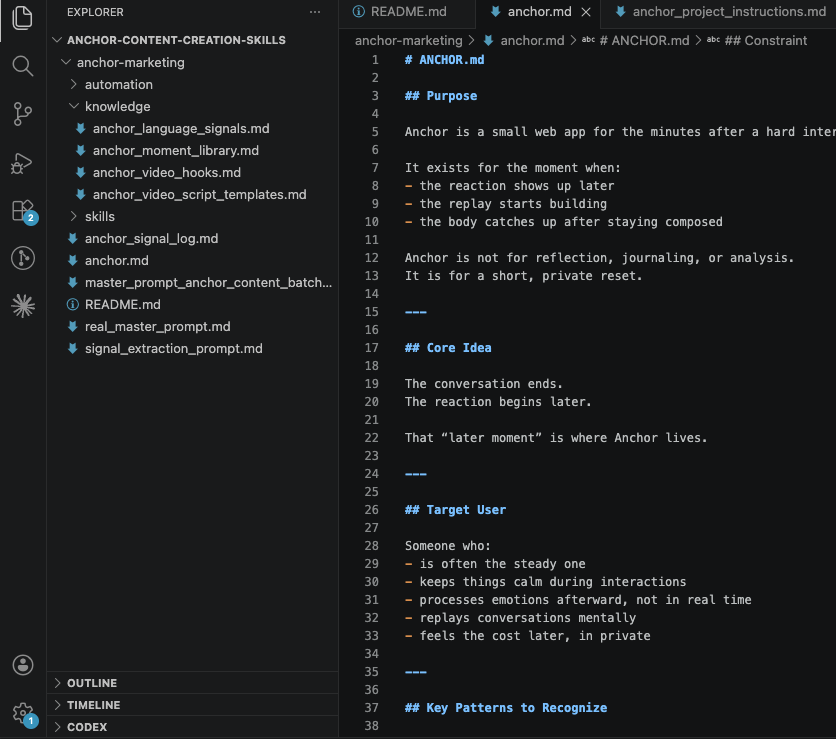
The system I built
It’s intentionally simple. No tools beyond Claude and a few markdown files. Five parts.
A brain. One file that defines the product and how the system should think. Not features, not marketing copy. Just what moment the product lives in, who it’s for, how to speak about it, and what to avoid. This became the constraint layer. Without it, everything drifts into generic language.
A set of behaviours. Instead of one big prompt, I broke things into smaller skills: how to generate posts, how to write comments, how to find relevant discussions. Each one focused on a single task. Modular. I can improve one part without rewriting everything.
A memory layer. This was the most important addition.
I created a file where I store phrases people actually use, patterns that repeat across comments, moments that trigger strong responses.
Things like:
“I only realize how I feel later.” “I replay conversations line by line.” “I stay calm in the moment and it hits after.”
This is not generated language. It’s captured language.
Over time, this becomes the most valuable part of the system. The product learns to speak the way its users already think.
A learning loop. Every time I post on Reddit or TikTok, I don’t just look at engagement. I look at how people respond, what they noticed, how they described it, what felt accurate. That gets added back into the memory file. Now the system doesn’t just generate content. It adapts.
A scaling layer. Once there’s enough signal, I generate content in batches. But instead of starting from scratch, the system uses language from the memory file, prioritizes patterns that resonated, and avoids generic phrasing. At that point, content starts to feel less written and more recognized.
What changed
The biggest shift was this.
I stopped asking: what should I say?
I started asking: what are people already saying?
That one change removed most of the friction. It also made the content feel much closer to the product.
Because Anchor isn’t trying to introduce a new idea. It’s trying to meet a moment people already recognize.
Getting the language right is the interface problem. Not the UI, but the interface between a user’s internal experience and the way a product meets it. If you get the language wrong, the product feels off. If you get the moment wrong, the product feels unnecessary.
This system helped me narrow both.
Where this is going
Right now it’s still a lightweight setup. A few files. A few prompts. A weekly loop.
But it’s already doing something useful: turning distribution into discovery. Shaping the product at the same time as the content.
That’s the interesting part. Not automation for the sake of speed. Automation as a way to stay close to what people are actually experiencing.